1. Systems and agents
The previous three pieces dealt with the tools of cognition. Abduction opens a space, the maxim and information judge what was opened, and intelligence split into three according to how the two are put to work. Now it's time to look at who holds those tools. Where did the subject of cognitive operations come from? That question has to start one level below biology.
Look at the thermostat on the wall of a room in winter. It takes in the air temperature, compares it with the setting, and switches the boiler on or off. A frame with this skeleton of input, transformation, and output is a system. A water wheel is a system too. Now imagine the thermostat is not a part fixed to a room but something that builds its own wall and keeps the temperature inside it. An agent is a system with that added property of being an independent unit. It has a boundary, and inside that boundary it maintains its own state as it runs. Lifeforms and living cognizers are both branches of the agent. So the first question is why anything like an agent shows up in the universe at all.
2. Entropy and time
In <Cognitive Axioms 02_2>, Shannon's entropy was the size of uncertainty. Shannon gave his formula the name entropy because it had the same shape as the thermodynamic formula for entropy. The formula that measured how far heat spreads and the one that measures how much you don't know share a structure. This time the word goes back to where it came from, thermodynamics, and we look at it as a flow.
Entropy only goes one way: up. Hot coffee cools, and cold coffee never warms itself back up. Most laws of physics still hold if you run time backward, but the increase of entropy has a direction. That makes it the physical clue that time is passing. Every real system is a dissipative system, raising entropy and scattering energy as it goes.
3. Attractors and Hamilton
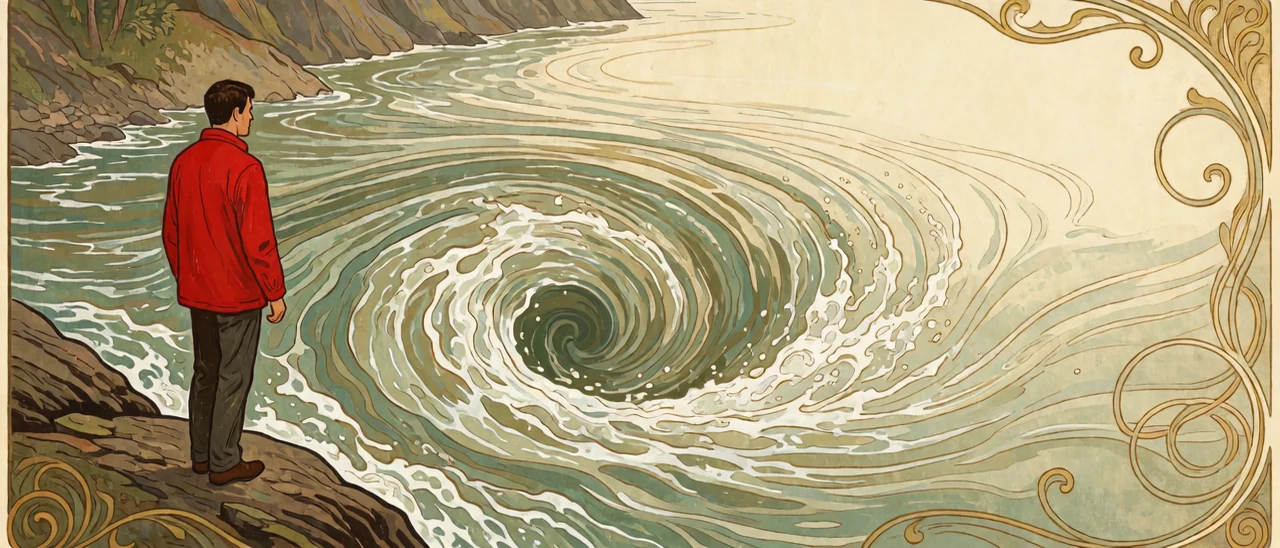
The trajectory of a dissipative system can't be predicted. The butterfly effect isn't the story that small variables produce big results; it's the story that no simulation, however precise, can ever match reality. Yet even unpredictable systems have order. Even from fairly different starting conditions, trajectories get pulled into a particular region of phase space and never leave it. A region that draws trajectories in like this is an attractor. Attractors that gather into a single point or run around the same loop are predictable. The attractors of chaotic systems are different. Trajectories stay trapped in the region, but inside it they never repeat the same path, and even trajectories that start right next to each other drift apart. This is called a strange attractor, and the Lorenz attractor is the classic example. Individual trajectories stay unpredictable to the end, yet the boundary the system never leaves can still be pinned down.
Hamilton's equations are the most elegant framework classical mechanics has, but they lay down one premise at the start: the system's change in entropy is dS = 0. They hold only for conservative systems where energy doesn't dissipate. Here S is entropy, not the action that appears when people talk about the principle of least action. Real systems have dS > 0, so the world Hamilton describes is a snapshot lifted out of the flow of dissipation.
Least action can be read, without a forced connection, as a special attractor pattern that emerges from within strange attractors under special conditions. Only in closed regions where the butterfly effect is held down far enough does an attractor show up as Hamilton's shortest path. Science is what we've achieved in those regions. It is a single droplet scooped from a vast ocean ruled by butterflies, and the entire physical basis of modern civilization stands on that droplet.
4. Faster dissipation, shorter path
The flow of rising entropy runs from a low-entropy starting point to a high-entropy end. Inside that flow, something odd happens: local order appears. Bathwater doesn't just drain; it forms a vortex. Water at the bottom of a heated pan organizes into honeycomb-shaped convection cells. Order looks like an exception to the law of entropy, and one view holds that it forms in the direction that speeds up how fast energy scatters.
Ilya Prigogine called these dissipative structures. An open system far from equilibrium builds local order while exporting entropy, and that order increases dissipation. Axel Kleidon of the Max Planck Institute for Biogeochemistry took this further. He views the whole Earth system as a hierarchy of dissipative structures drawing work out of solar energy, and hypothesizes that life evolves to push its dissipative activity to the limit and then push the limit itself higher. This line of work goes under the name of the Maximum Entropy Production (MEP) principle, and Kleidon lays it out in the paper "Life, hierarchy, and the thermodynamic machinery of planet Earth." The principle is not a settled law but a contested hypothesis, and it is not the only candidate explanation for the emergence of life. This essay accepts the hypothesis and builds on it.
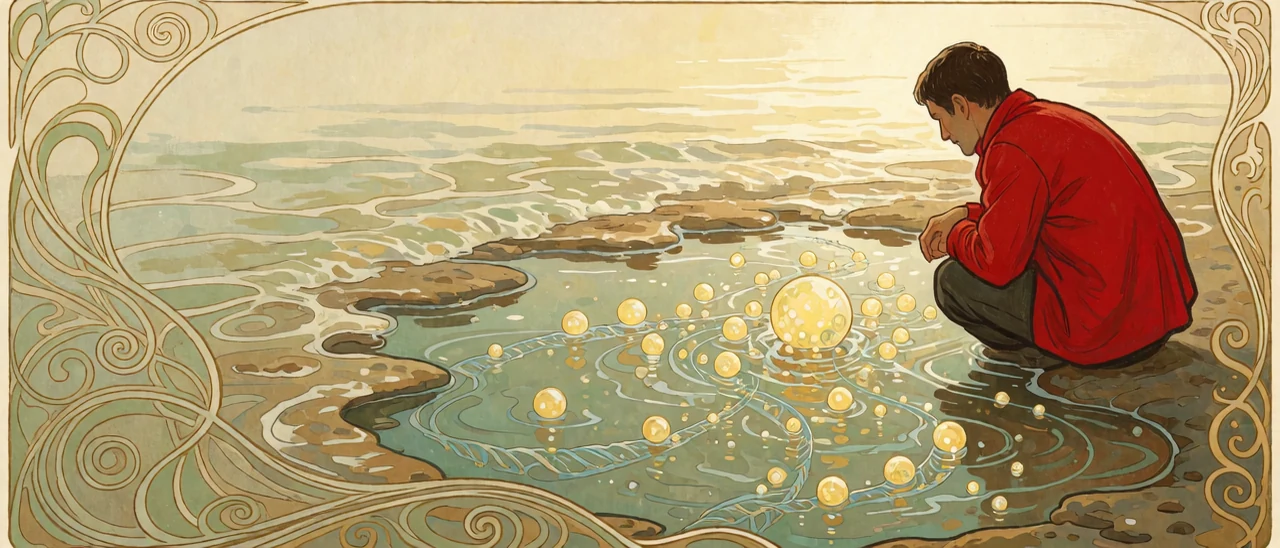
The key word here is not dissipation but acceleration. A cooling stone dissipates too. What makes local order special is that it produces entropy faster than would happen without it. It's a device that shortens the path from start to end. This piece calls such order a dissipation accelerator.
5. Inside and outside, split by a membrane
Dissipation accelerators weren't finished in one step. At each Goldilocks threshold where conditions lined up, a phase convergence made something real, and what was made real became the condition for the next threshold to appear. Each stage is the footing for the next. The established foothold of <Cognitive Axioms 01_0> repeats on the timescale of the universe.
One decisive rung of that ladder is the outer membrane. The outer membrane splits an inside from an outside, and the agent's boundary becomes a physical structure. Inside it, a concentration and arrangement different from the outside takes hold — a local order. The first and representative case is the cell membrane. Lipid molecules in water gather tail to tail, their water-shy ends together, and form double-layered pouches on their own.
The outer membrane doesn't stop at a single layer around a cell. When cells gather into an individual, skin, shells, exoskeletons, and bark become the outer membrane of the whole individual. The material of the outer membrane need not even be living tissue. Diatoms wear shells of silicon dioxide — the stuff of glass — and clams wear shells of calcium carbonate. Coral polyps secrete calcium carbonate to build coral stone, an exoskeleton shared by the whole colony. When the polyps die the stone remains, and the next generation builds on top of it, so the outer membrane itself becomes the next generation's foothold. A tree holds the same structure within a single individual. Most of its trunk is dead tissue. What lives is the thin cambium and phloem just inside the bark, plus the leaves, buds, and root tips; even the vessels that carry water are tubes of dead cells emptied out and joined end to end. The dead tissue serves as prop and waterway, holding up the thin living layer. In between, organs sit as intermediate structures, each wrapped in its own membrane. The individuals filling today's ecosystems are structures made of nested boundaries: organ membranes on top of cell membranes, and the individual's outer membrane on top of those. Whatever the scale, the job is the same: split inside from outside and guard the order within.
Left alone, the order inside the membrane collapses. The natural dissipation of leaking, mixing, and scattering never stops pulling the inner order down toward equilibrium. For a membraned structure to last, it has to keep rebuilding its inside against that flow, and that takes energy. The first reason lifeforms use energy is to defend the order inside them against dissipation from outside.
6. From photons to ATP
The most common source of that defensive energy is a nearby star. When photons from the sun are absorbed by pigment molecules, their energy is turned into chemical bonds and stored. Lifeforms break that stored energy into small units as a molecule called ATP and spend it wherever it's needed: guarding the membrane, carrying materials, rebuilding structure. ATP is the energy currency of lifeforms.
This scene is one case of accelerated dissipation. Photons scatter into heat in the end even without lifeforms. Lifeforms catch those photons, put them to work, and then release them as heat. Guarding the order inside, seen from the whole outside, adds one more path by which energy scatters and makes it faster. Defense and acceleration are one motion.
7. Replication and expansion
Environments change, and a structure once built can only hold out so long as it is. Lifeforms grow their structure, expand it, split it in two, and each individual makes the next. As replication and expansion repeat, slightly different variants appear, and those that fit the changed environment remain. This is the mechanism by which evolution happens.
Once a self-copying structure stabilized inside these ATP-using structures, that structure was secured as a foothold in the form of a blueprint: DNA. ATP and DNA are not two devices acquired separately. The A in ATP, adenine, is also one of the four bases that make up DNA. DNA is the foothold where the replicating structure of an energy-using structure hardened and passes on to the next individual.
To sum up, a lifeform is an agent that is a structure split off from the outside by a membrane, that defends its inner order against dissipation from outside by spending, as ATP, energy obtained from a star's photons, and that repeats replication and expansion and secures its replicating structure in DNA, so that it evolves along with a changing environment.
8. Emergence without a designer
Lifeforms are not an exception to the law of entropy. Under the MEP hypothesis, they are agents that organized themselves, on top of the flow of rising entropy, in the direction that accelerates that flow. Explaining this emergence needs no designer. The moment you ask why it was designed that way, you've already assumed a designer, and you've walked into the frame of Plato's theory of Forms, where a perfect original comes first. Flow, attractors, and thresholds are enough to describe the emergence plainly.
The next piece takes up how these lifeforms acquired eyes, brains, and hands and came to handle symbols, and how, at the end of that road, the living cognizer — the subject of cognitive operations — appeared.