Matter is an energy quantum on a field's eigenmode
mass is its frequency in time at rest in space
01Order — time comes first, energy next, entropy after that
Which physical quantity gets defined first? My candidates: the E in E=mc², and the S in dS>0.
Of the two, E comes first. S carries energy inside its own definition. In thermodynamics, dS = δQ_rev / T, and Q is energy. In statistical mechanics, S = k ln Ω, and Ω counts the microstates available at a given energy E. dS > 0 is not the definition of S but the second law, and E = mc² is not the definition of E but a relation.
Step outside the candidates and the first quantity defined is time. The SI fixes the second first, then defines the metre and the kilogram by leaning on it.
Isn't time derived from the fixed value of the speed of light?
The speed of light is a conversion ratio, length/time, so on its own it supplies no scale at all. The second is fixed by the caesium-133 transition frequency, 9 192 631 770 Hz; the metre is then obtained from the second by fixing the speed of light. The direction of derivation is time → (c) → length.

02Energy — energy isn't something that happens to be conserved; it is defined as what is conserved
What's Noether's theorem?
It says that every continuous symmetry of physical law fixes one conserved quantity. Emmy Noether proved it in 1918.
| What you can change without changing the law | Conserved quantity |
|---|---|
| Shift in time | Energy |
| Shift in space | Momentum |
| Rotation | Angular momentum |
Energy comes out of the symmetry that the laws don't change over time. Time has to exist before you can talk about energy.
So energy isn't conserved. Energy is whatever we defined as the thing that's conserved.
Yes. What has to be checked by observation moves from energy to the symmetry. Where the symmetry breaks, conservation breaks too. In an expanding universe, total energy conservation does not hold in general.
History has the same shape. When conservation seemed to fail, physicists didn't drop the law; they looked for the missing term. In 1930 Pauli proposed the neutrino to cover energy that went missing in beta decay, and the neutrino was later detected.
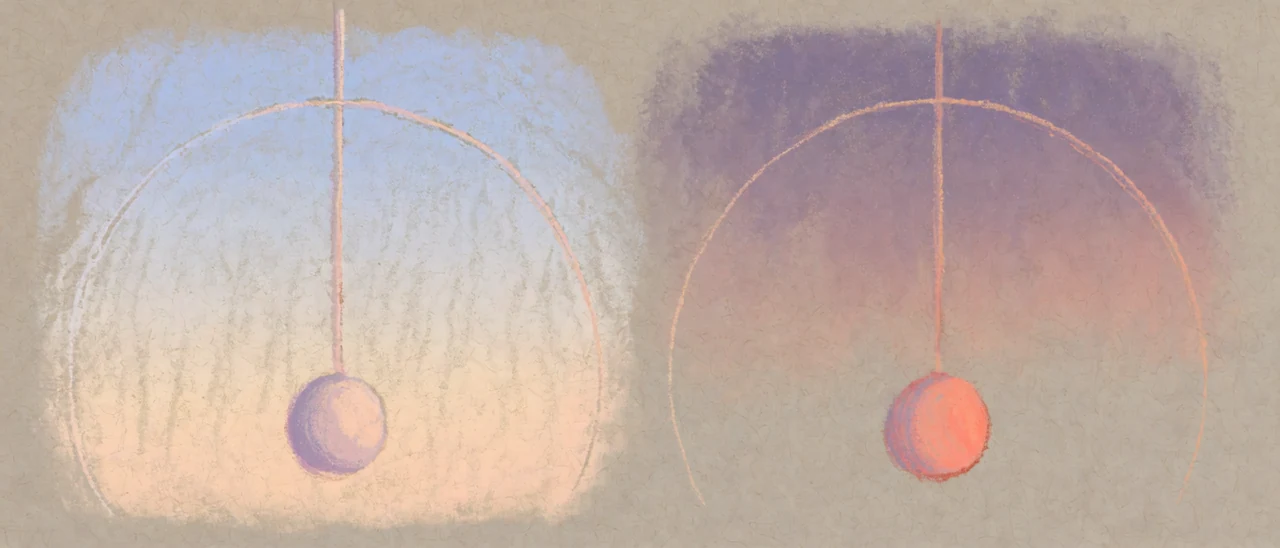
03Conservation of mass — strictly speaking, classical conservation of mass holds nowhere in the universe
Once you move to conservation of energy, classical conservation of mass completely collapses because of E=mc², in the strict sense.
What collapses is mass's standing as an independent conservation law. The sum of the rest masses of the parts is not conserved. A deuteron is lighter than a proton and a neutron weighed separately; the missing share left as binding energy.
What survives is the invariant mass of an isolated system as a whole. In M²c⁴ = E² − p²c², E and p are conserved, so M is conserved along with them. Mass is not conserved on its own; it is conserved as a consequence of energy and momentum conservation.
The same thing happens when you boil water. Heating 1 kg of water from 20 ℃ to 100 ℃ puts in 334 400 J and adds 3.72 ng of mass; boiling all of it away puts in another 2 257 000 J, for 28.8 ng in total. This uses a specific heat of 4.18 kJ/(kg·K) and a heat of vaporization of 2257 kJ/kg. On the stove's side, the fuel and oxygen get lighter by the energy they release. Mass moves wherever energy moves, in every reaction, so no process conserves mass separately.
Lavoisier's conservation of mass looked right because the energy of chemical reactions is so small next to mc² that no scale could catch it. It was right as an approximation and wrong as a law.
04The two nuclear forces — the strong force binds; the weak force changes kinds
Of the four forces, explain the two nuclear ones properly.
The strong force. It acts between quarks and gluons, and its version of charge is colour charge. Gluons carry colour charge themselves, so gluons pull on each other. That is why pulling quarks apart doesn't weaken the force: the energy you put in makes new quark pairs, and a quark is never seen alone (confinement). At very short distances the coupling does the opposite and weakens (asymptotic freedom). The nuclear force that holds nuclei together is this force leaking out past protons and neutrons as a residual, and its range, set by the pion mass, is 1.41 fm.
The weak force. It is the only force that changes what a particle is. Beta decay, where a down quark inside a neutron turns into an up quark and the neutron becomes a proton, is this force at work. Its carrier, the W, weighs 80.4 GeV/c², so the range is only 0.0025 fm. It is weak not because the coupling is small but because the carrier is heavy; at high energies it merges with electromagnetism into a single electroweak force. It is also what turns a proton into a neutron in the first step of the Sun's fusion, and because that step is slow, the Sun burns for billions of years.
Strictly there are three slots. Electromagnetism and the weak force are unified as the electroweak force, and gravity sits outside the Standard Model.
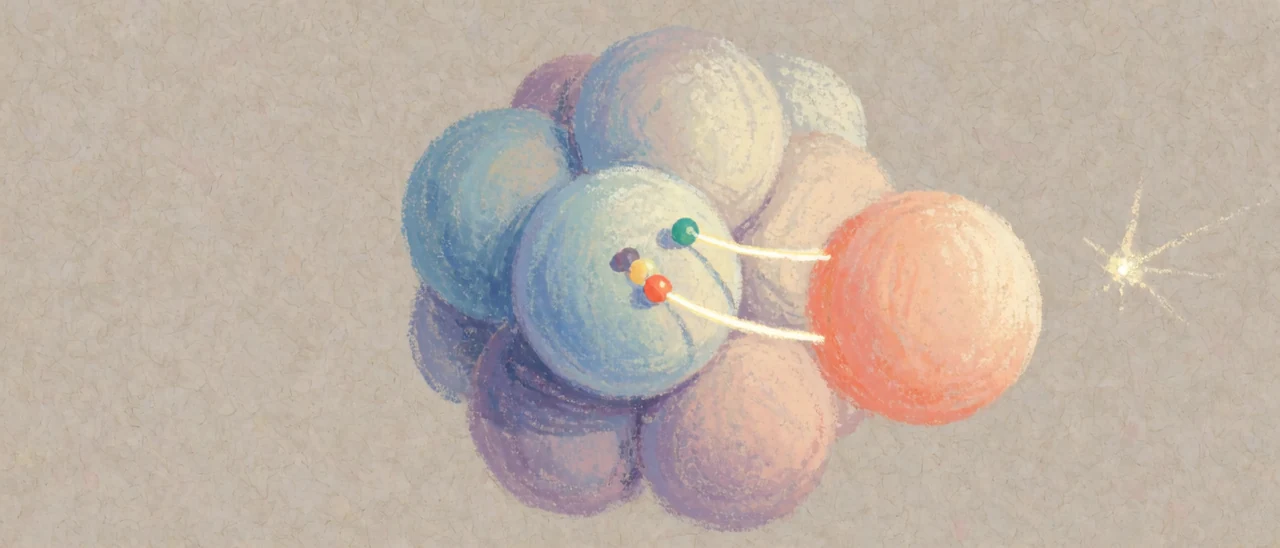
05Where mass comes from — nearly all of atomic mass is the energy of quarks confined by the strong force
So what makes most of the mass we know, atomic and molecular weight, is the strong force confining quarks, plus the conversion of the kinetic energy of quarks running around inside that confinement.
Right. Only the word "conversion" needs fixing. The energy a bound system holds simply is that system's mass; nothing turns into anything. Confinement and kinetic energy are cause and effect. Quarks squeezed into a small space get large momentum from the uncertainty principle, and that kinetic energy together with the gluon field energy makes up more than 99% of the proton's mass.
| Item | Share of nucleon mass |
|---|---|
| Quarks' own mass, from the Higgs | 0.96% |
| Electron mass | 0.054% |
| Mass lost to nuclear binding (iron-56) | −0.94% |
Take that head-in-the-clouds definition of mass, multiply by Earth's gravitational acceleration, and you get the weight we've been using for thousands of years, right?
Yes, W = mg. What makes the multiplication legitimate is the equivalence principle, that inertial and gravitational mass are the same, and that is an observed fact checked to 10⁻¹⁵, not a definition. What people weighed on balance scales for thousands of years was closer to mass than weight, because the same g acts on both pans and cancels out.
Newton set up mass as the first definition in the body of the Principia: the quantity of matter is the measure of it arising from its density and bulk conjointly. That is where mass was first defined apart from weight, and Newton swung pendulums of different materials to show that mass is proportional to weight to one part in a thousand, an experimental test of the equivalence principle. The definition is criticized as circular, since density is already mass divided by volume. Mach pointed this out in an 1883 book.
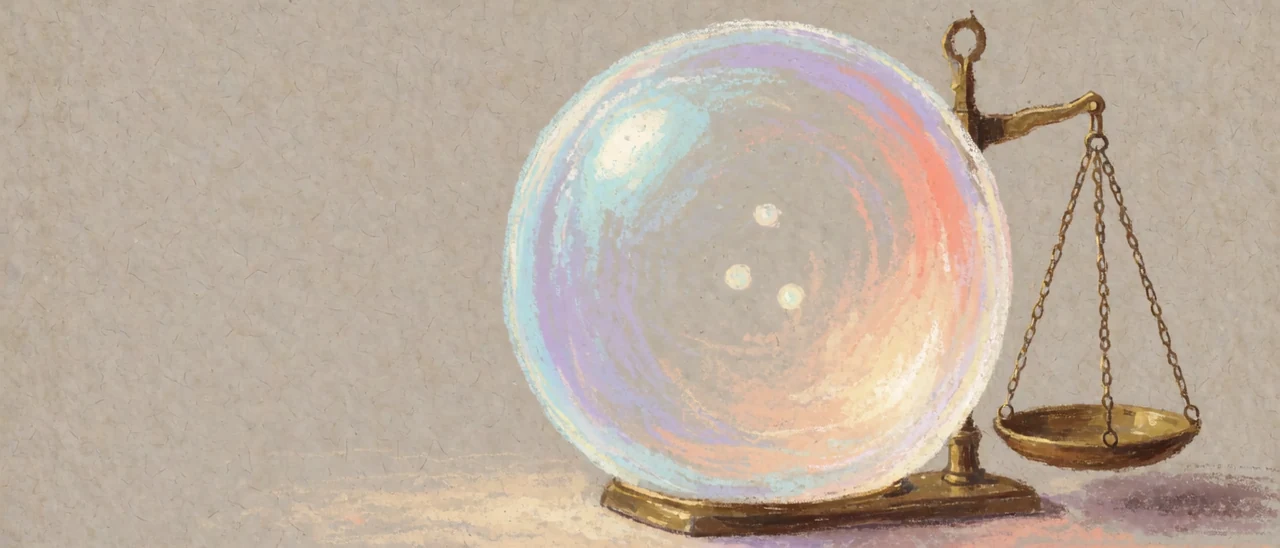
06Particles — a particle is a lump of energy with a rest frame, and mass is that lump's rest energy
So E=mc² doesn't mean particles turn into energy; it means there's no such thing as a particle?
"Turn into" is the wrong phrase. Energy is a property of things, not a material things turn into. In pair annihilation the energy is the same amount from start to finish; only the form of what carries it changes. The verdict that a particle is not a hard little ball comes from quantum field theory. The basic entity is the field, and a particle is an excitation of it.
Doesn't the very concept of mass presuppose particles?
What mass presupposes is a system with a rest frame: a single bundle for which you can take a view where total momentum is zero. Two photons flying apart each have zero mass, yet taken as one system they have mass.
Quit playing with words. A system with a rest frame, a single bundle for which you can take a view where total momentum is zero: that's a particle.
Correct. In the rebuttal I narrowed "particle" to elementary particles while taking the premise of mass in the broad sense of a bundle, mixing two meanings. Define a particle as an energy bundle with a rest frame, and mass does presuppose particles. That matches the classical notion of a point mass too. Particle and mass are defined together, as a pair.
Atomism originally said everything in the universe is assembled from atoms, minimal units that can't be split any further. Then once you get into electrons and nuclei, it turns into Lego bricks of particles, and nobody knows how far down the splitting goes. Then past E=mc², it becomes: every one of those particles is really just a lump of energy. A system with a rest frame, a single bundle for which you can take a view where total momentum is zero: put it in one word and it's just a lump.
Along that path, the meaning of splitting changes too. Split an atom and you get electrons and a nucleus; split a nucleus and you get protons and neutrons. Smash a proton in an accelerator and what comes out is not parts that were inside, but new lumps made from the collision energy. At the bottom, splitting turns into making. The minimal unit doesn't disappear; it moves. The minimum is no longer in the size of matter but in the amount by which a field can be excited.
indivisible grain → divisible parts → countable lumps of energy
07Quanta — only energy quanta sitting on sinusoidal modes on the mass shell become matter
So only coherent fluctuations, sinusoidal ones, become matter?
Yes. A free field decomposes into sinusoidal modes, and one particle is one energy quantum sitting on one such mode. The only fluctuations that fly off as particles are those whose frequency and wavenumber satisfy (ħω)² = (ħkc)² + (mc²)², a relation called the mass shell. Fluctuations off it are virtual particles; they don't get far, and their job is to carry forces.
"Coherent" should be replaced. In physics a coherent state is the laser-like, near-classical wave whose particle number isn't fixed, which is the opposite of a countable lump.
And that's the concept of the quantum in quantum physics.
Yes. The energy of a mode with frequency ω rises only in steps of ħω, one step, two steps, and the number of steps is the number of particles. Planck introduced this unit for black-body radiation in 1900, and in 1905 Einstein took light itself to come in lumps of it. Energy levels inside an atom follow the same principle. Energy comes in steps because waves split into eigenmodes and each mode has a single frequency.
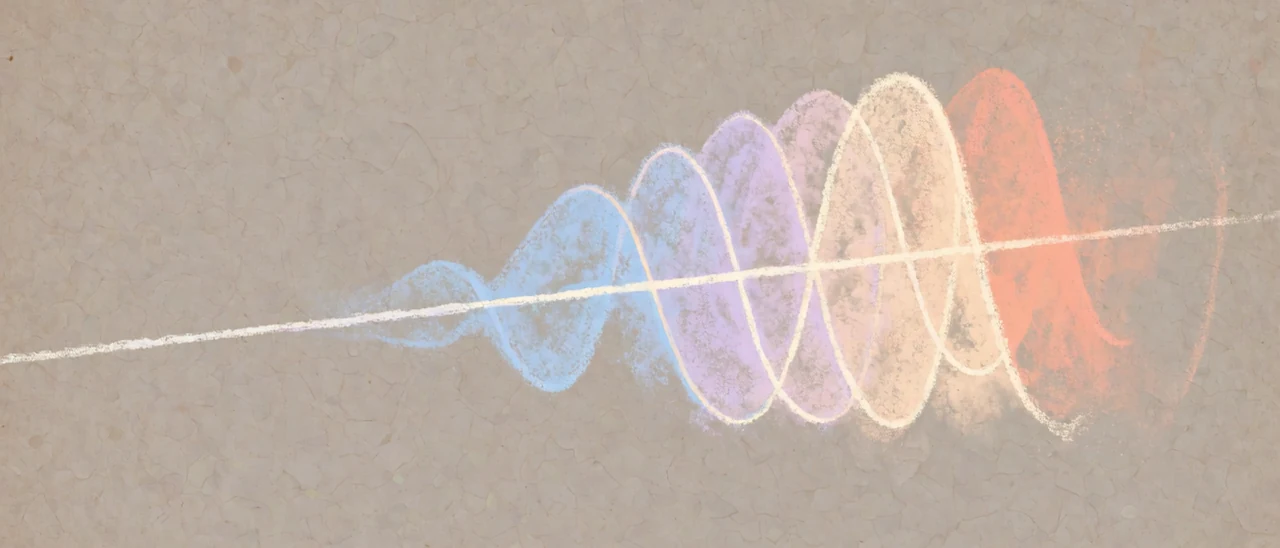
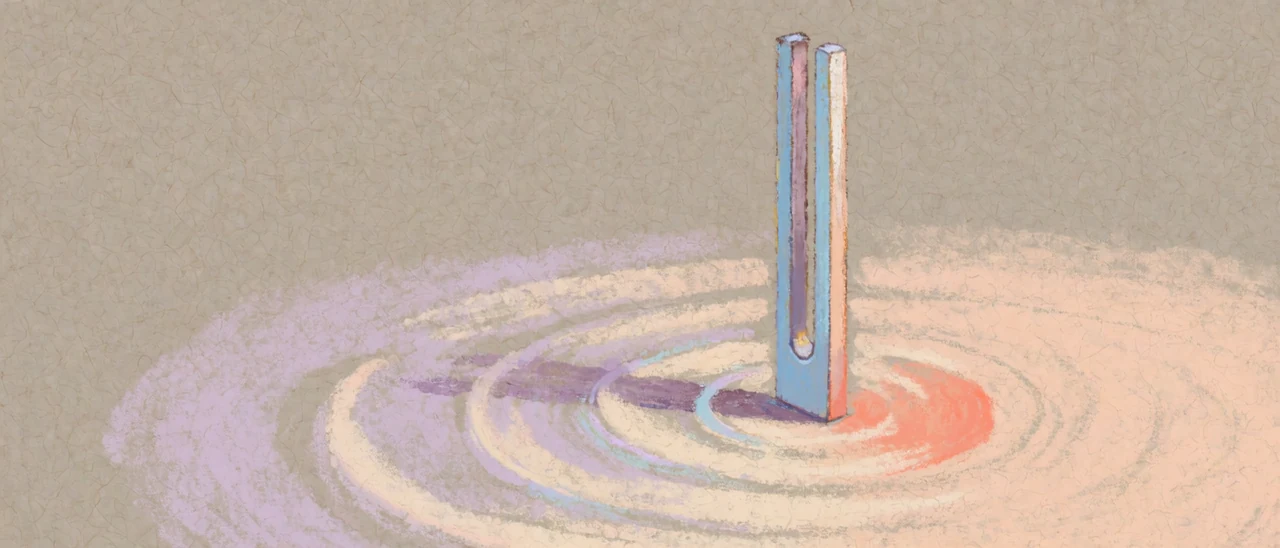
08Rest and oscillation — mass is frequency in time while at rest in space
"Frequency" and "rest" look like they contradict each other.
Rest is a word about space; frequency is a word about time. The wave of a lump at rest has zero wavenumber in space, so it is uniform everywhere, and its phase turns over time. The electron's rest frequency is mc²/h = 1.2356×10²⁰ Hz. Motion adds oscillation along space and raises the total frequency, so the rest frequency is the minimum. Read through relativity, mass is the rate of the clock inside the lump.
Then you should say "frequency in time while at rest in space." That makes it clear.
That phrasing names the axes. "Rest frequency" left out which axis the rest belongs to, so it read as a contradiction. Multiply by h/c² and you get a value in kilograms; the constant only changes units, and the quantity stays the same.
09Origin — E=mc² is the speed of light that ties time to space, showing up again between energy and mass
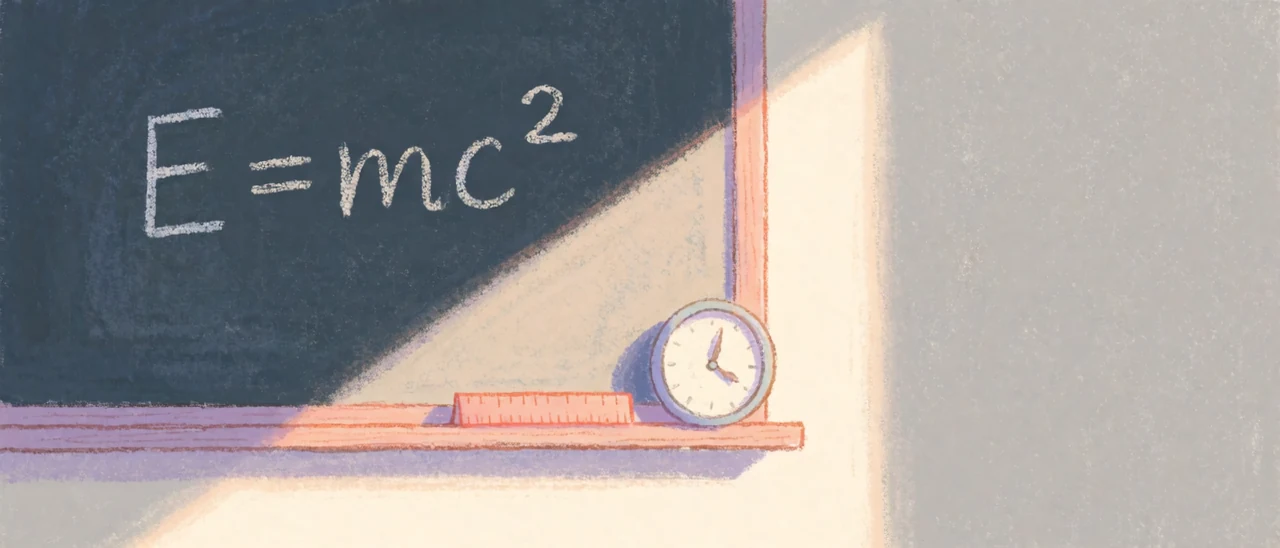
Where on earth did E=mc² come from?
From Einstein's 1905 paper "Does the Inertia of a Body Depend Upon Its Energy Content?" A body at rest emits two beams of light in opposite directions, with total energy L. To an observer moving past, the Doppler effect makes the light's total energy look like γL. For energy conservation to hold for both observers, the extra (γ − 1)L has to come out of the body's kinetic energy. The speed is unchanged, so what decreased is the mass, by L/c².
Structurally, the invariance of the speed of light mixes time and space through the Lorentz transformation, and the same transformation binds energy and momentum into a single four-vector. The length of that vector is mass. In E² = (pc)² + (mc²)², set p = 0 and E = mc² is what remains. The mass-shell relation above is this equation with E = ħω and p = ħk substituted in.
10Path
| Step | Strike | Point narrowed |
|---|---|---|
| 01 | Which comes first, E or S; is time derived from c | time → energy → entropy; c is a bridge, not a scale |
| 02 | Not conserved, but defined as the conserved thing | energy is defined as the conserved quantity of time symmetry |
| 03 | Conservation of mass collapses, strictly | it is not an independent law but a consequence of energy conservation |
| 04 | The two nuclear forces, properly | the strong force binds; the weak force changes kinds |
| 05 | Atomic mass is confinement plus kinetic energy | nearly all atomic mass is the energy of confined quarks |
| 06 | Quit playing with words; that bundle is a particle | particle = lump of energy with a rest frame |
| 07 | Only sinusoidal fluctuations become matter | quanta on sinusoidal modes on the mass shell |
| 08 | Frequency and rest contradict | mass = frequency in time while at rest in space |
| 09 | Where did E=mc² come from | the length of the energy–momentum four-vector |
Matter is an energy quantum on a field's eigenmode
mass is its frequency in time at rest in space